Skip to content
Search
Menu

These bookings earn us a commission through Viator. You pay the same, and the money played no part in the selection.

Things to Do

ArtPrize: Seventeen Days When the City Becomes the Gallery

Last updated

ArtPrize turns downtown Grand Rapids into an open gallery each autumn. Current dates, how voting works, where the venues cluster and what it is really like.

For a little over two weeks each autumn, roughly a thousand works of art appear across downtown Grand Rapids and the city stops behaving normally. They go into galleries and museums, which you would expect. They also go into bank lobbies, hotel bars, church halls, shop windows, brewery taprooms, the river itself and the middle of Rosa Parks Circle. There is no selection committee deciding what gets in. Any artist may enter, any downtown venue may host, and for the duration the city is the gallery.

The 2026 edition opened on 18 September and runs to 3 October, with a preview week from 12 September during which most of the work was already installed and the crowds had not yet arrived. Voting opened at noon on the opening Friday. Those dates move by a few days each year, and the event has changed format and organiser more than once, so treat any year-specific detail you read anywhere — including here — as something to confirm against the organisers before you book a flight.

The history matters because it explains what you will see. Rick DeVos founded ArtPrize in 2009 with a prize pool built round a quarter of a million dollars awarded entirely by public vote, which made it the richest art prize in the world at the time and provoked a decade of argument about whether that was a good idea. A juried track was added in 2010, and by 2014 the competition ran two equal streams, public and juried, at two hundred thousand dollars each. The 2020 edition was postponed. It returned in 2022 in restructured form and is now run as a partnership between the City of Grand Rapids, Downtown Grand Rapids Inc. and Kendall College of Art and Design. The organisation now reports distributing more than four hundred thousand dollars straight to artists through the two voting tracks, plus over two hundred thousand a year in grants.

What that produces is an event with no quality floor and no ceiling. You will stand in front of something genuinely good and, ninety seconds later, something that should not have left the garage. That is not a flaw in the execution. It is the design, and whether you enjoy ArtPrize depends almost entirely on whether you find that liberating or exhausting.

Attendance for the 2025 edition was estimated at more than nine hundred thousand across the run. For a city of this size that is a different place for seventeen days: hotel rooms go, the ramps fill, restaurants run waits on a Tuesday. Plan accordingly, and read the section below on when to actually walk it.
Our picks

The ones we would book

  • Editor's Pick

    Best guided walk for getting your bearings downtown

    Why we chose it

    None of the city's bookable tours is an ArtPrize tour, and any that claims to be is repackaging a general walk. What a guided downtown walk is genuinely good for is the first two hours of a first visit: which bridge goes where, which block is Monroe North, why the Calder is on the bin lorries. Do it early in the trip, then walk the venues yourself.

    Walking Food Tour Downtown Grand Rapids

    Olive Oil Tasting

    Editor's PickFree cancellationSmall group

    Walking Food Tour Downtown Grand Rapids (opens in a new tab)

    4 reviews

    Discover the flavors of downtown Grand Rapids on this guided walking food tour! Sample a delightful mix of savory and sweet dishes from…

    3 hours

    Prices checked

    from $80

How an open-entry competition works

Two lists have to find each other. Artists register an entry; venues register as hosts. Then each side picks the other, which is the part outsiders never guess: a sculptor in Ohio has to persuade a restaurant in Grand Rapids to give them a wall. Nobody vets the art. The result is that a museum-standard installation and a teenager's first canvas can hang two hundred yards apart, both legitimately in the competition.

Because venues are ordinary businesses, the geography of the event is the geography of downtown commerce. That means a lot of it is indoors, which matters in late September in Michigan, and a lot of it keeps that business's hours, which matters if you arrive at nine in the evening expecting a bank lobby to be open.

Entries are grouped into categories for the juried awards — two-dimensional, three-dimensional, installation, time-based and new media — alongside visibility and independent awards that other organisations fund and judge. The public vote runs in parallel on its own track.

Recent editions have carried more than a thousand entries across well over a hundred venues. You will not see them all. Nobody sees them all, including the judges, and the sooner you accept that the better a day you will have.

The other structural fact worth knowing: entering is free to walk. There is no ticket for ArtPrize. Individual venues that normally charge admission, such as the museums, still charge it.

The venue clusters, and how to walk them

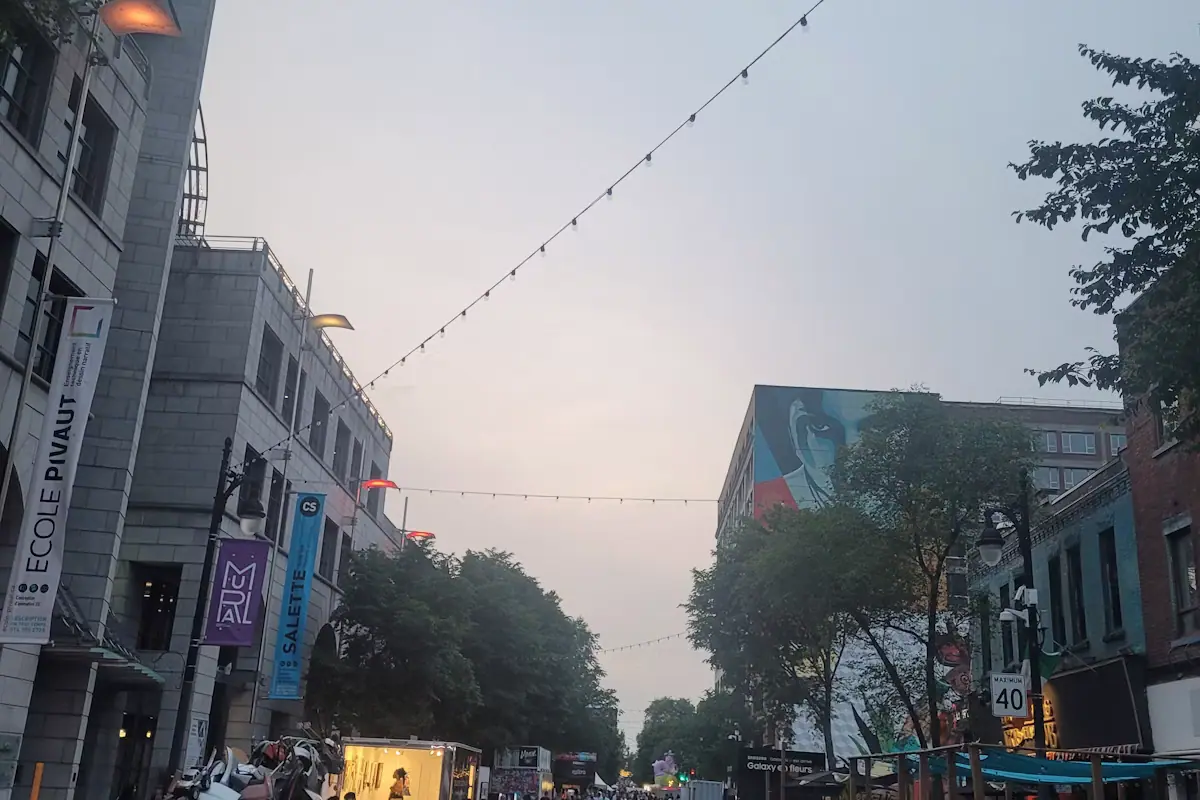
People walking along a pedestrian street of low buildings strung with lights in the evening

When to go

Downtown Grand Rapids is compact, which is the whole reason this event is possible here and not in a bigger city. The walkable core runs roughly from the Grand River east to Division Avenue and from Fulton Street north to the Monroe North district, and you can cross the entire thing on foot in about twenty-five minutes.

Work the clusters rather than the map.

The riverside and Monroe Center. The heaviest concentration: the art museum, the hotels on Monroe and Pearl, the office lobbies, and Rosa Parks Circle, which takes the largest installations because it is the only downtown space with the room.

The west bank. Across the river by the Public Museum and the Ford Museum, with the pedestrian bridges doing a lot of work. Quieter, and the walk between banks is part of the pleasure.

South Division and the Avenue for the Arts corridor. The most interesting cluster for anyone who actually follows contemporary art, and consistently the least crowded.

Monroe North and the brewery district. Taprooms, old furniture-factory buildings, and the cluster where you should finish rather than start.

Two hours gets you one cluster properly. A full day gets you three at a jog. If you have a single afternoon, pick South Division and the riverside and skip the rest without guilt.

Voting, and what the public vote actually rewards

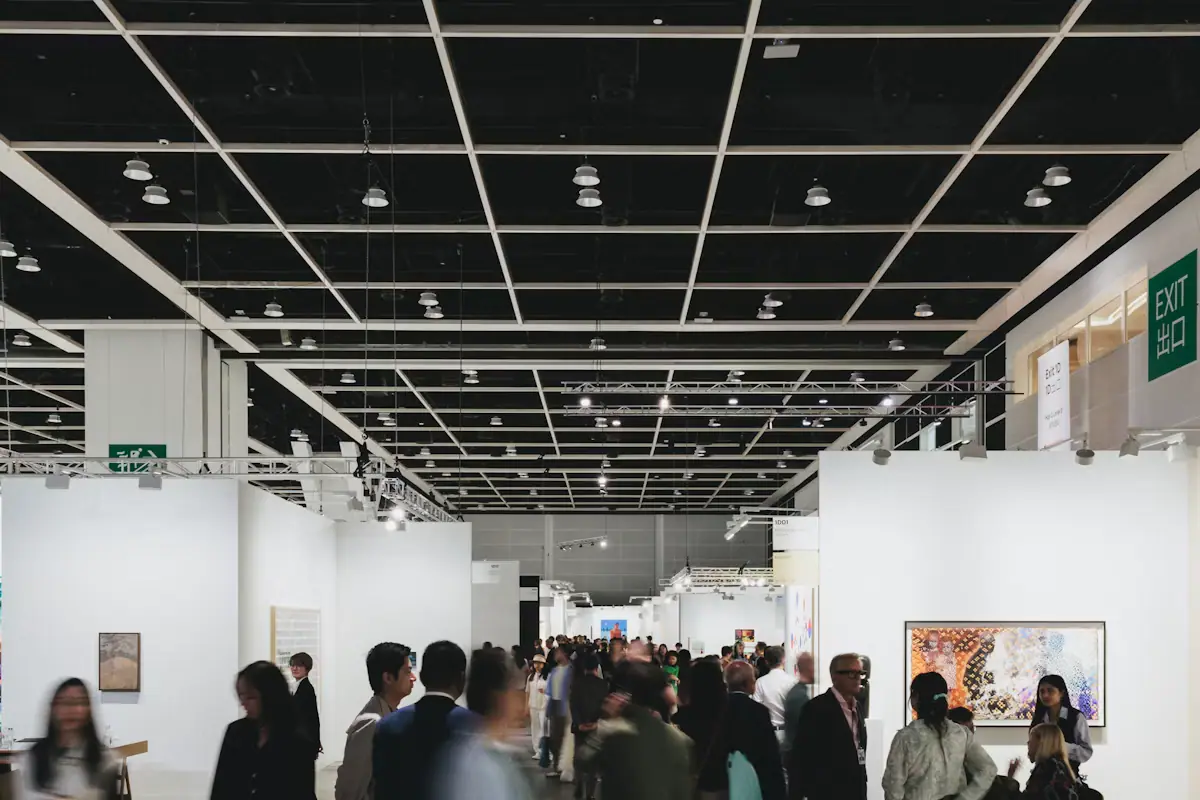
Visitors walking through a long, brightly lit exhibition hall hung with artworks

Anyone can vote. You register, you get a code, you vote for entries you have actually stood in front of. Voting opens with the event — at noon on the opening Friday in 2026 — and runs in rounds, narrowing to finalists before a final vote decides the public award. The juried track runs alongside it and is decided by invited judges rather than by you.

Here is the part worth understanding before you get annoyed about the result. A public vote across several hundred thousand people rewards what a large mixed crowd responds to in ninety seconds: scale, craft you can see the labour in, sentiment, and subjects with a ready-made constituency. It has consistently done so since 2010 and critics have complained about it for just as long. The juried track exists precisely because that is true.

This is not a reason to dismiss the public vote. It is a reason to treat the two lists as answering different questions. The juried shortlist is the better guide to what is worth crossing town for. The public shortlist is a fascinating document about what half a million midwesterners find moving, which is its own kind of interesting.

Practical note: vote as you go rather than at the end. The registration takes two minutes and the codes are posted at the venues. People who leave it until the last evening discover the round has closed.

Rooms, ramps and the weather

Local tips

  • Book accommodation early. Seventeen days of very high demand in a downtown with a finite number of hotel rooms does what you would expect to rates and availability. If downtown is gone, the East Beltline and the 28th Street corridor are fifteen to twenty minutes out by car and considerably cheaper.
  • Use the municipal ramps, not the surface lots. Downtown parking ramps charge by the hour, they are covered, and during the run they are the difference between a parking space and a twenty-minute circuit. Park once and walk; driving between clusters in this event is slower than walking.
  • Weekday mornings are the trick. The preview week before voting opens is the best-kept advice on this page: most work installed, a fraction of the crowd. Failing that, a Tuesday or Wednesday morning is a different event from the final Saturday.
  • The last weekend is the busiest by a wide margin, because the finalists have been announced and everybody wants to see them.
  • Dress for late September in Michigan, which can mean seventy-five degrees and sun or fifty degrees and horizontal rain, sometimes in the same afternoon. Layers, and shoes you can walk five miles in.
  • Eat off-peak. Restaurants downtown run genuine waits on weekday evenings during the run. Lunch at eleven-thirty, or dinner at five, or book.
  • It is free to walk. The only money this event needs from you is what you choose to spend in the venues hosting it.

Dates, and why you should check them

ArtPrize has opened in the second half of September and closed in the first days of October for most of its existence, and the 2026 edition ran from 18 September to 3 October with a preview week beginning on the 12th. That is the shape to plan around: mid-September into early October, a little over a fortnight, with the busiest days at the end.

It is a shape rather than a rule, and this event in particular has earned its caveats. It was postponed entirely in 2020. It returned in 2022 under different management with a different prize structure. The organisation running it now — a partnership between the city, Downtown Grand Rapids Inc. and Kendall College of Art and Design — is not the organisation that ran the first decade, and the awards have been restructured more than once along the way.

So the standing advice: confirm dates, voting rounds and the venue list with the organisers before you commit to flights, and be suspicious of any article that quotes a year without saying when it was written. This page was last checked on 21 September 2026, three days into that year's run.

One last thing. If your trip cannot line up with the autumn, you have not missed the city's art. The Calder has stood on its plaza since 1969, Maya Lin's rink freezes every winter, and the sculpture collection at Meijer Gardens is there in February with nobody in it. The art and galleries page covers the other three hundred and forty-eight days.

Book it

Everything else we track

We could not find tours matching this right now

Nothing came back for Grand Rapids walking tour. Operators add and retire experiences constantly, so this list changes week to week. Try a broader category, or come back in a day or two.

The quality problem, stated plainly

Before you book

An unjuried competition with a thousand entries contains a thousand entries' worth of everything. A reasonable estimate of how much of it will interest a person who goes to galleries by choice is: not most of it.

That is the deal, and there are two ways to take it. The bad way is to try to see everything, which produces a specific kind of fatigue by the fourth hour and a conviction that the whole thing is a craft fair with a marketing budget. The good way is to accept that you are prospecting. Walk a corridor, look at twenty things, find two that are worth standing in front of, and go and have a beer. Come back tomorrow and do another corridor.

Two further honesty notes. The 2022 return drew real criticism locally for the reduced scale of the work on show compared with the early years, when entries included things floated on the river and hung off buildings. Some of that scale has come back and some has not; it depends on the year and on who funded what.

And the venue problem cuts both ways. Art in a working restaurant means you are looking at a painting over somebody's dinner, and art in a shop means you feel obliged to buy a coffee. Both are fine. Neither is a gallery, and if you want quiet contemplation in front of a good painting, the art museum is charging admission fifty yards away and is much the better bet.

On the ground

Where to go

Every place below has its own page — hours, parking, what it costs and what to expect when you get there.

  • The Grand River running past low riverfront buildings in downtown Grand Rapids

    Museum

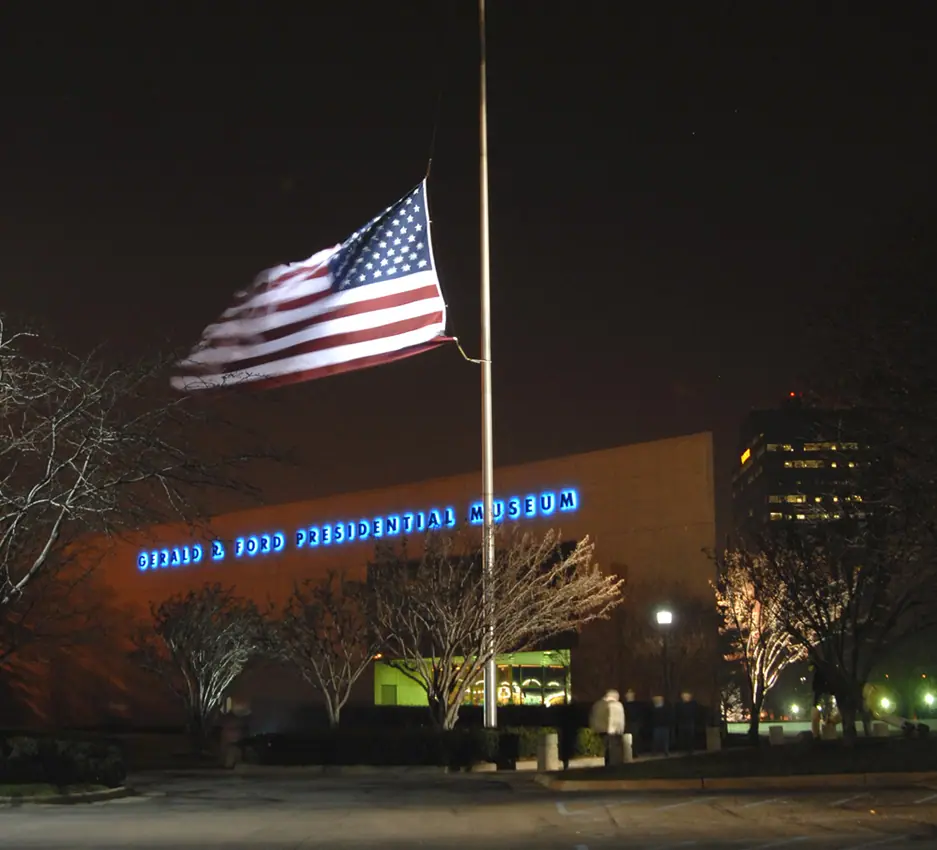
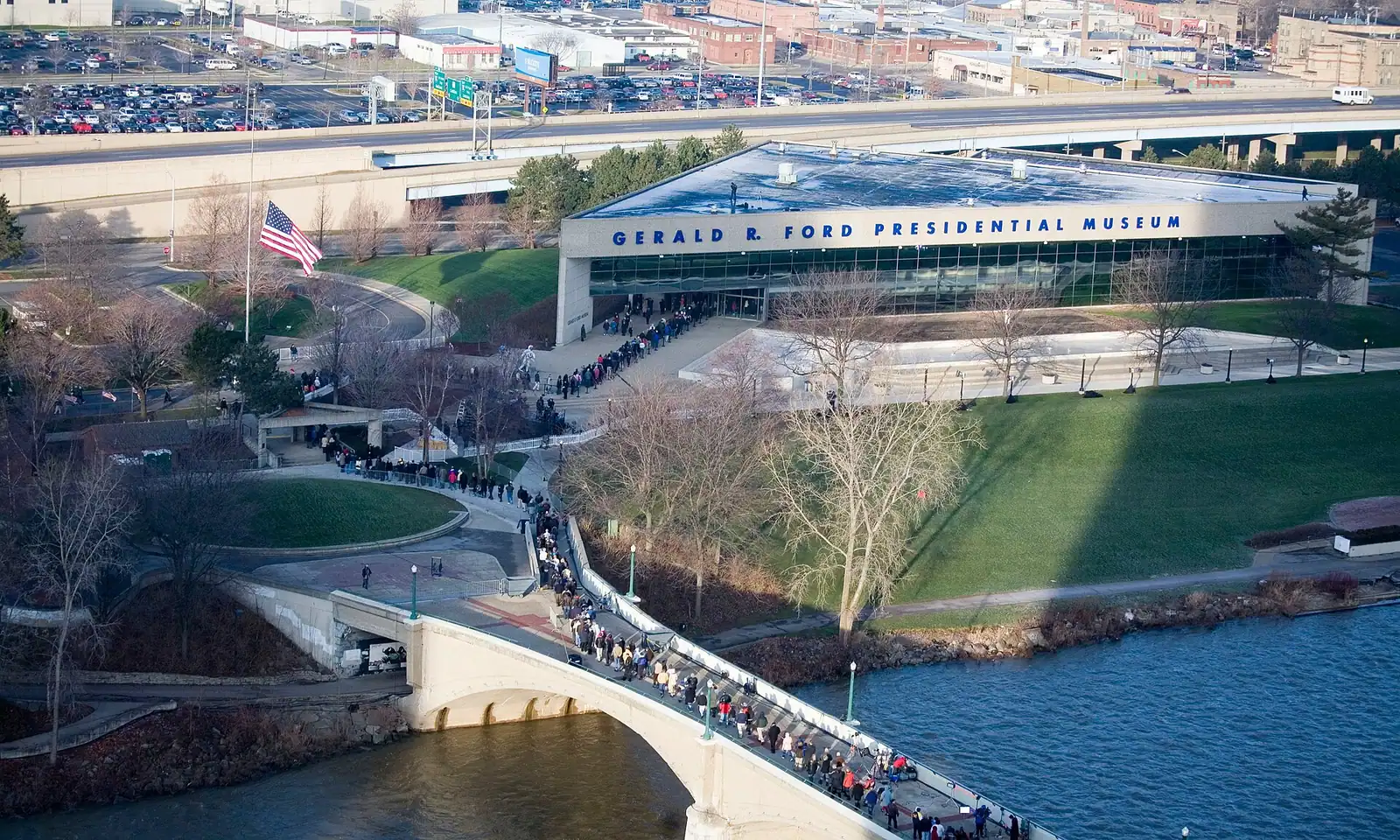
    Gerald R. Ford Presidential Museum

    A presidential museum on the riverbank where the 38th president and his wife are buried a short walk from the front door.

    1.5–2.5 hoursAround $15–20 per adult; the gravesite on the grounds is free to visit

  • People standing in front of a warehouse wall covered in large multicoloured murals

    Landmark

    Free

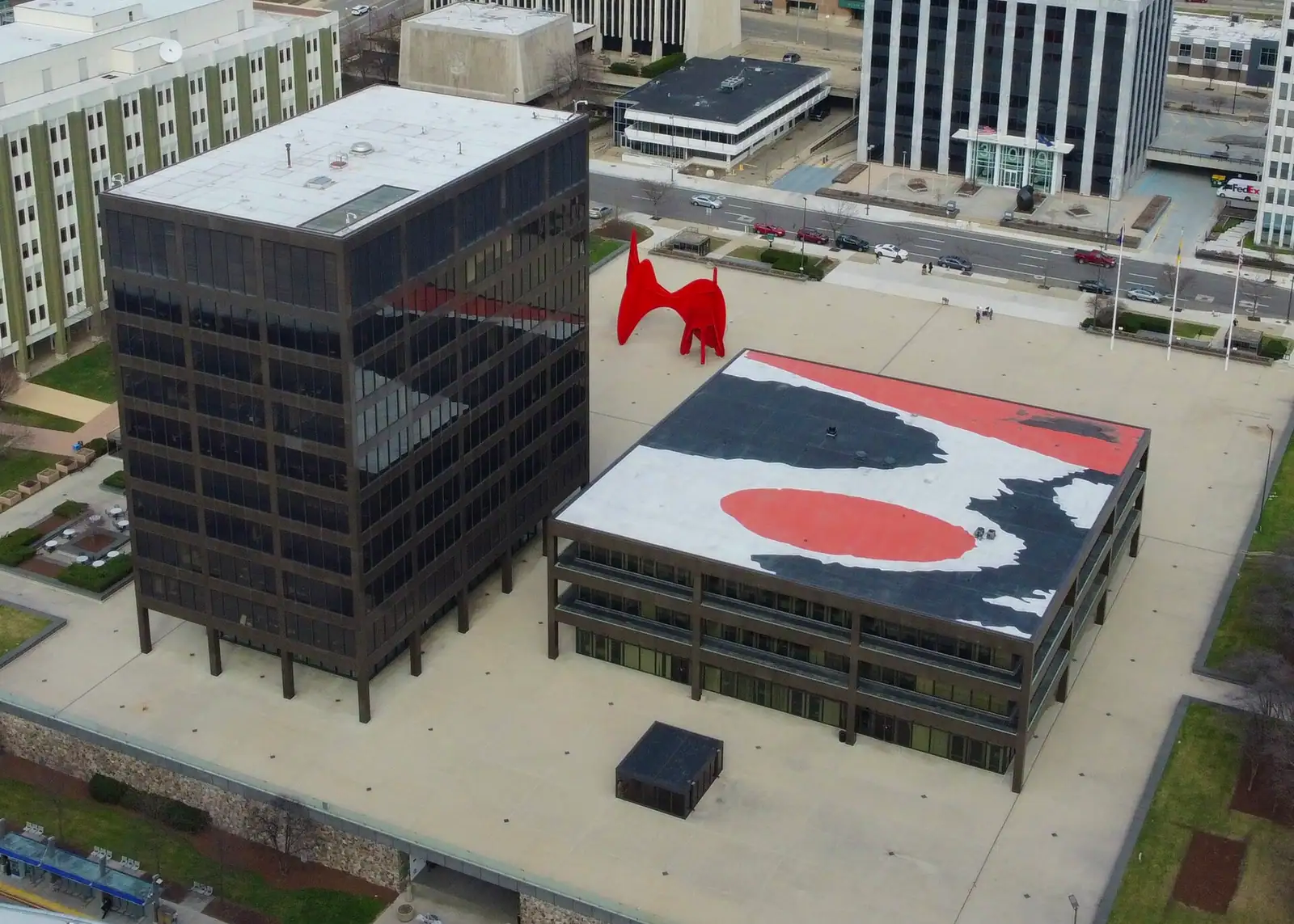
    Calder Plaza

    Forty-two tons of vermilion steel that changed how a furniture town saw itself, and the Calder painting on the roof behind it.

    15–45 minutesFree. An open civic plaza with no ticketing at any time of year.

  • Visitors standing in a daylit gallery looking at a large painting on a white wall

    Museum

    Grand Rapids Art Museum

    The first LEED Gold certified art museum anywhere, built by a city whose fortune came from making furniture well.

    1.5–2.5 hoursRoughly $10–15 per adult; general admission free on Thursday evenings

  • Ornate painted carousel horses inside a glass pavilion with a city skyline beyond

    Museum

    Grand Rapids Public Museum

    A 76-foot whale hangs over the Galleria, an 1890s street runs through the basement, and the 1928 carousel turns beside the river.

    2–3.5 hoursAround $12–16 per adult; carousel rides and planetarium shows cost extra

  • Brick storefronts and a wide pavement on a city street in early evening light

    Landmark

    Free

    Rosa Parks Circle

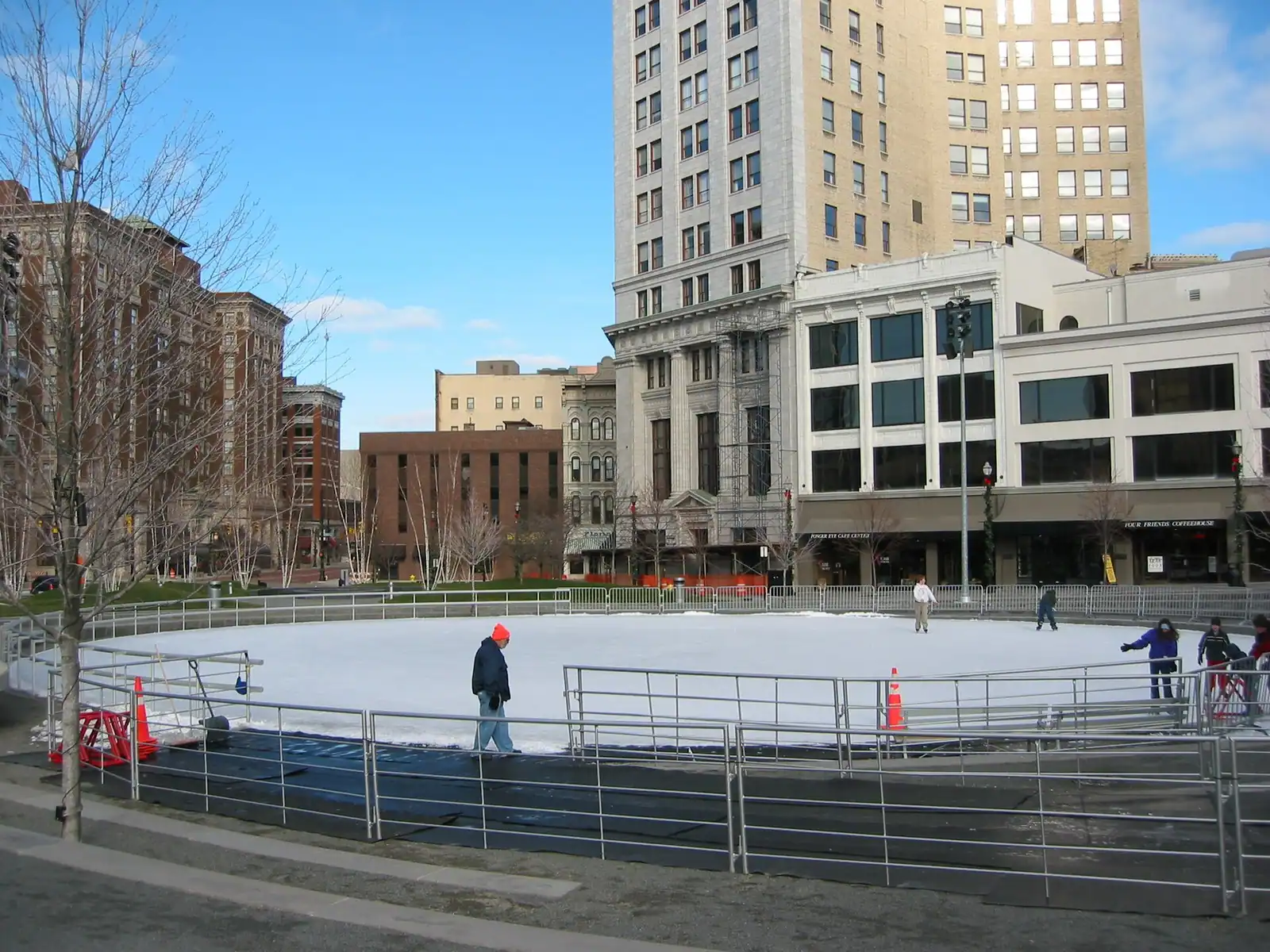
    A Maya Lin artwork you are allowed to walk on, and from December a public ice rink with the night sky under the ice.

    0.5–2 hoursThe plaza is free at all times. Winter skating sessions carry a small charge.

  • A river running past open ground with city buildings rising behind

    Park

    Free

    Ah-Nab-Awen Park

    Six and a half acres on the west bank whose name means resting place, with grass mounds that stand for the burial mounds once here.

    0.5–1 hoursFree. Some festivals held in the park are separately ticketed

  • A row of tall beer glasses on a bar counter in front of brewery tanks

    Dining district

    Free

    Monroe North

    The furniture district that built the city, now lofts, offices and the brewery that moved back in a decade after Founders moved out.

    1–3 hoursFree to walk. You pay for what you drink and eat.

  • A bright, white-walled gallery with framed works hung along both sides and daylight at the far end

    Museum

    Free

    Urban Institute for Contemporary Arts (UICA)

    Grand Rapids lost its contemporary art centre in 2023. Here is what happened to UICA and where the work moved to.

    0.5–1 hoursNot applicable — the institution is closed. Its successor galleries at Kendall are free.

Straight answers

Questions people actually ask

When is ArtPrize in Grand Rapids?

Mid-September into early October, running a little over a fortnight. The 2026 edition ran from 18 September to 3 October, with a preview week from 12 September when most of the work was already installed and the crowds had not arrived. Dates shift by a few days each year and the event has changed organiser and format more than once, so confirm with the organisers before booking travel rather than trusting any article's stated year.

Is ArtPrize free?

Yes. There is no ticket to walk ArtPrize and no charge to vote. Roughly a thousand entries are distributed across downtown venues — galleries, museums, hotel lobbies, shop windows, churches, brewery taprooms and public spaces — and you walk between them at your own pace. Venues that normally charge admission, such as the Grand Rapids Art Museum and the Public Museum, still charge it during the run.

How does ArtPrize voting work?

You register for a voting code, then vote for entries you have actually seen. Voting opens with the event and runs in rounds, narrowing to a finalist shortlist before a final round decides the public award. A separate juried track, decided by invited judges, runs in parallel with its own award categories. Register and vote as you go: people who leave it to the last evening find the round has already closed.

How much does ArtPrize pay the winner?

The structure has changed several times. The 2009 competition awarded a $250,000 grand prize decided purely by public vote, the largest art prize in the world at the time. From 2014 the event ran parallel public and juried tracks at $200,000 each. The organisation now reports distributing more than $400,000 directly to artists across both voting tracks, plus over $200,000 a year in grants to eligible participating artists.

Who runs ArtPrize now?

It is run as a public/private partnership between the City of Grand Rapids, Downtown Grand Rapids Inc. and Kendall College of Art and Design of Ferris State University. That is not the organisation that ran the first decade: Rick DeVos founded the event in 2009, the 2020 edition was postponed, and it returned in restructured form in 2022. This is why older articles describe a prize structure that no longer applies.

How long does it take to see ArtPrize?

You cannot see all of it, so plan by cluster rather than by entry. Two hours covers one downtown cluster properly. A full day at a brisk pace covers three. With a single afternoon, take the South Division corridor and the riverside around Rosa Parks Circle and skip the rest. Recent editions have run past a thousand entries across well over a hundred venues, and nobody, judges included, sees them all.

Where do you park for ArtPrize?

Use the downtown municipal ramps rather than hunting surface lots. They charge by the hour, they are covered, which matters in late September rain, and during the run they are the difference between parking and circling. Park once and walk, because driving between venue clusters is slower than walking them. If downtown rooms and ramps are full, the East Beltline and 28th Street corridors are fifteen to twenty minutes out.