Park
Free
Ah-Nab-Awen Park
Six and a half acres on the west bank whose name means resting place, with grass mounds that stand for the burial mounds once here.
0.5–1 hoursFree. Some festivals held in the park are separately ticketed440 ft away
Museum
Last updated
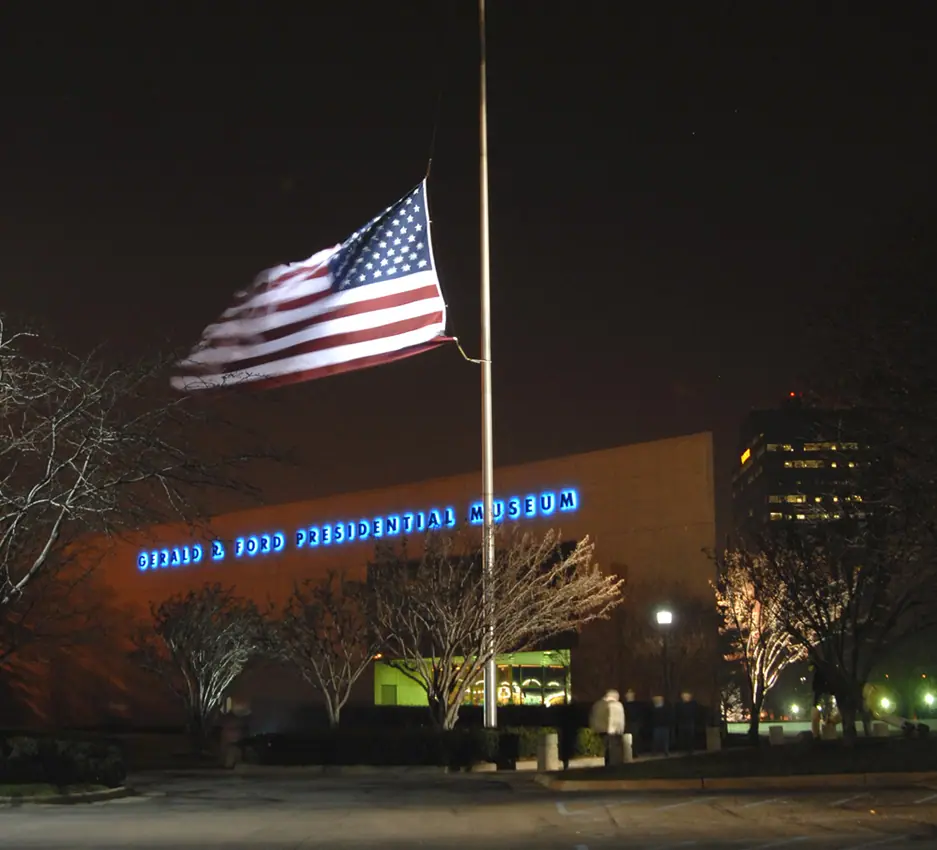
A presidential museum on the riverbank where the 38th president and his wife are buried a short walk from the front door.
Photo: UnknownPublic domain
Gerald Ford was born in Omaha and named Leslie King. He grew up here, in Grand Rapids, went to South High School, and represented Michigan's fifth district in Congress for twenty-five years before a chain of resignations put him in an office nobody had elected him to. The museum on Pearl Street is the city's account of that, and it is unusually candid about it.
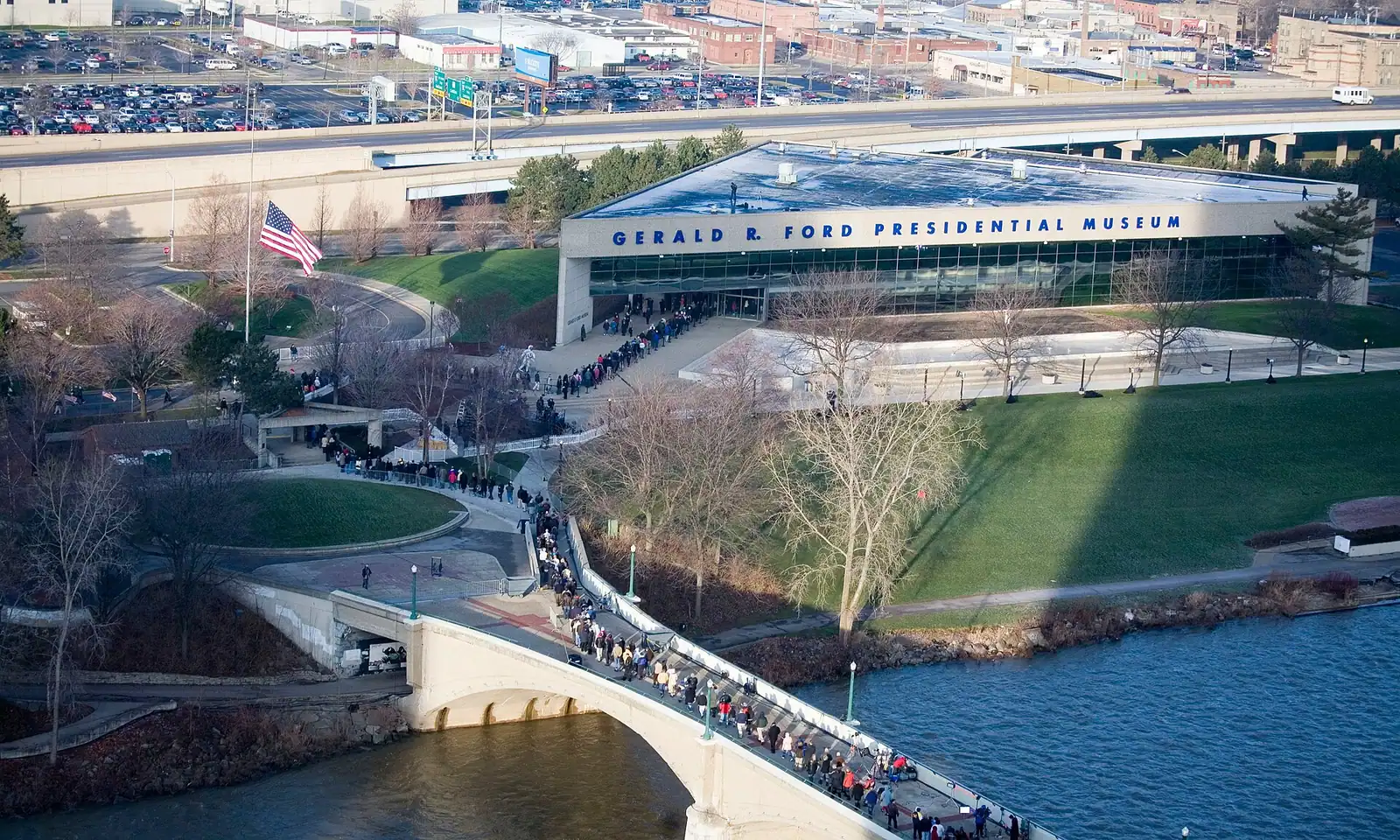
The building opened in 1981 on the west bank of the Grand River, a low 44,000-square-foot block with a mirrored glass face toward the water. Inside, the main floor holds a full-scale replica of the Oval Office furnished as Ford kept it, and the 2003 education addition carries a reproduction of the White House Cabinet Room with an interactive treatment of three decisions: the Nixon pardon, the Mayaguez rescue, and the near-bankruptcy of New York City.
Two objects do most of the work. The Watergate gallery shows the actual tools the burglars carried into the Democratic National Committee offices in June 1972, which is a strange and sobering thing to stand in front of. And in the diplomacy room is the staircase from the roof of the United States embassy in Saigon, up which the last Americans climbed to the helicopters in April 1975. It is the real one, not a copy, and it is the single most affecting thing in the building.
President Ford died in December 2006 and was interred on the museum grounds. Betty Ford was buried beside him in July 2011. The hillside tomb sits on the north lawn above the river, open to the public daily during daylight hours and free to visit whether or not you go inside. There is no ticket booth between the pavement and the grave, and the etiquette expected is the ordinary etiquette of a cemetery.
Allow ninety minutes indoors. Allow a few more outside.
The museum stands on the west bank of the Grand River at Pearl Street, beside the Pew campus of Grand Valley State University and a five-minute walk across the river from Monroe Center. Visitor parking is on site.
On foot from downtown, cross at the Pearl Street bridge or take the Blue Bridge and turn south along the west-bank path. From the Grand Rapids Public Museum it is a few hundred yards south along the same riverwalk.
Driving in from US-131, take the Pearl Street exit and you are there in under a minute. The Gerald R. Ford Freeway, which is I-196 through the city, runs immediately north of the site and is named for the man buried on the lawn.
The tomb sits on a bank above the Grand River, north of the main entrance and reached by a paved path from the museum plaza. A low curved wall, a lawn, the river below. Gerald Ford was interred here on 3 January 2007 after a funeral at Grace Episcopal Church in East Grand Rapids; Betty Ford was buried beside him in July 2011.
Access is free and separate from museum admission. The grounds open in the early morning and close in the late afternoon, typically from around 7:45am to 5pm, and you can walk in from the riverwalk without passing a desk. Confirm current hours with the museum if you are making a special trip.
This is a working memorial, not an exhibit. Visitors leave flowers and challenge coins. If you are travelling with children who have spent an hour in a replica Oval Office, it is worth a sentence on the path to explain what they are about to look at.
The river path continues north from here toward Ah-Nab-Awen Park and the Public Museum, which makes the grave a natural stop on a downtown riverfront walk rather than a detour.
The permanent exhibition is chronological and moves briskly: a Grand Rapids boyhood, a wartime Navy posting, a long congressional career, then the compressed 895 days of the presidency.
The Oval Office replica is full scale and furnished as it stood between 1974 and 1977, down to the desk and the drapes. The Cabinet Room reproduction in the education centre handles three decisions with interactive displays, so you can sit at the table and work through the pardon, the Mayaguez, and New York's fiscal crisis as they were argued.
Betty Ford gets substantial and deserved space. Her candour about breast cancer, addiction and mental health changed what an American first lady was allowed to say in public, and the museum treats that as a major part of the story rather than a footnote.
There is also a changing exhibition gallery, added with the 2003 extension, which rotates through travelling shows on twentieth-century political and social history. Check what is on before you go, because it can add an hour.
Photography is generally permitted in the permanent galleries. Bags may be checked. This is a federal facility operated by the National Archives, and it feels like one.
Presidential libraries usually pair the archive with the museum on one site. Ford's does not. The Gerald R. Ford Presidential Library sits on the University of Michigan campus in Ann Arbor, about two and a half hours east; the museum is here in Grand Rapids. They are one institution administered by the National Archives, split across two cities, which is unique among presidential libraries.
The reason is straightforward: Ann Arbor was Ford's university, Grand Rapids was his home town and his political base. Rather than choose, the arrangement kept both. If you are a researcher, the papers are in Ann Arbor. If you are a visitor, everything you want is here.
The Grand Rapids connection runs through the city beyond the museum. The federal building downtown carries his name, so does the international airport south of the city, and the highway along the river is the Gerald R. Ford Freeway. For a city that has spent thirty years rebuilding its riverfront, having a president buried on it is not a small part of the civic self-image.
Straight-line distances, so allow more on the road — the island is long and has one main parkway.
Park
Six and a half acres on the west bank whose name means resting place, with grass mounds that stand for the burial mounds once here.
0.5–1 hoursFree. Some festivals held in the park are separately ticketed440 ft away
Museum
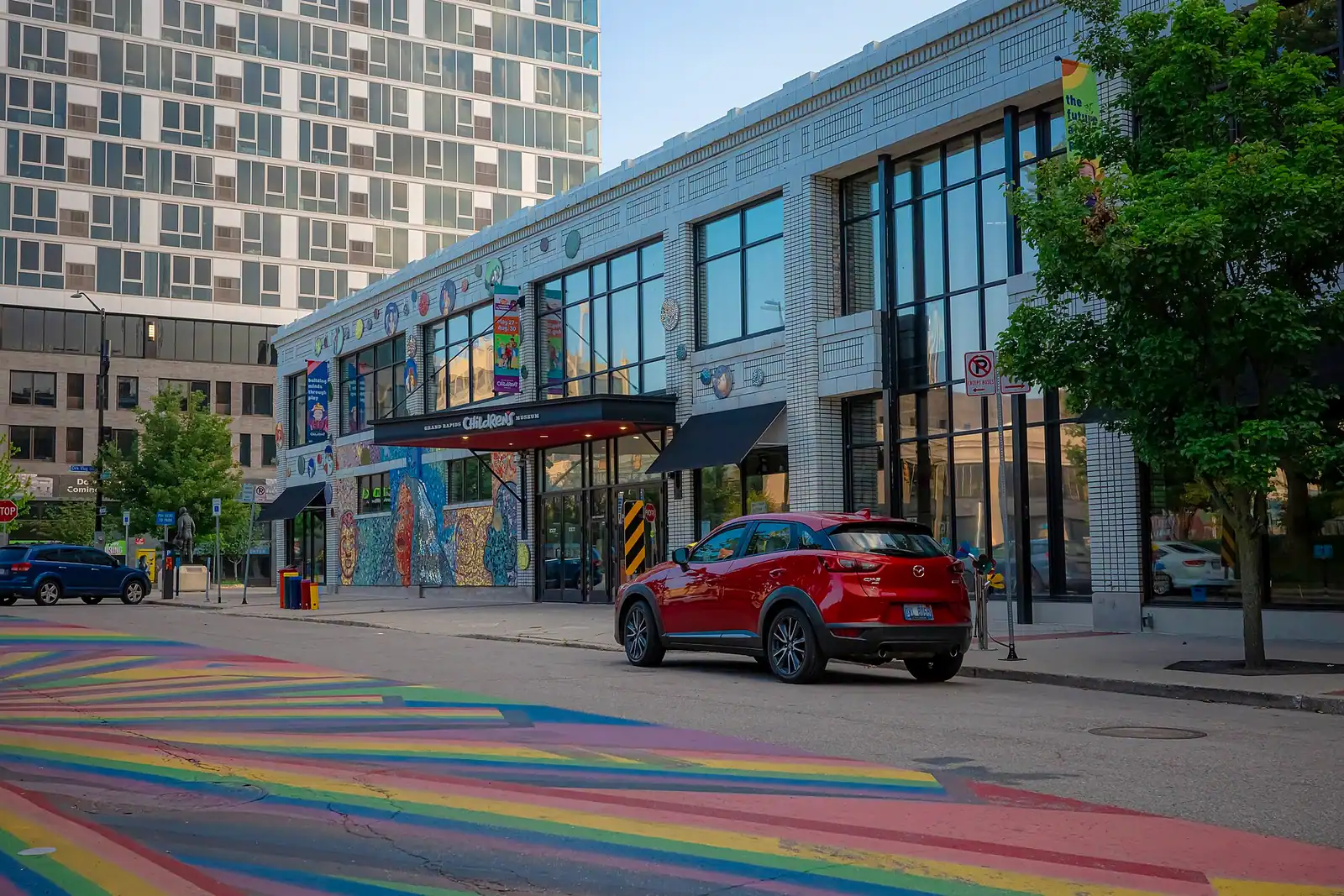
A 76-foot whale hangs over the Galleria, an 1890s street runs through the basement, and the 1928 carousel turns beside the river.
2–3.5 hoursAround $12–16 per adult; carousel rides and planetarium shows cost extra1,000 ft away
Trail
A downtown loop on both banks of a river that is currently being torn up so it can have its rapids back.
1–1.5 hoursFree. Parking is the only cost and that is a downtown ramp890 ft away
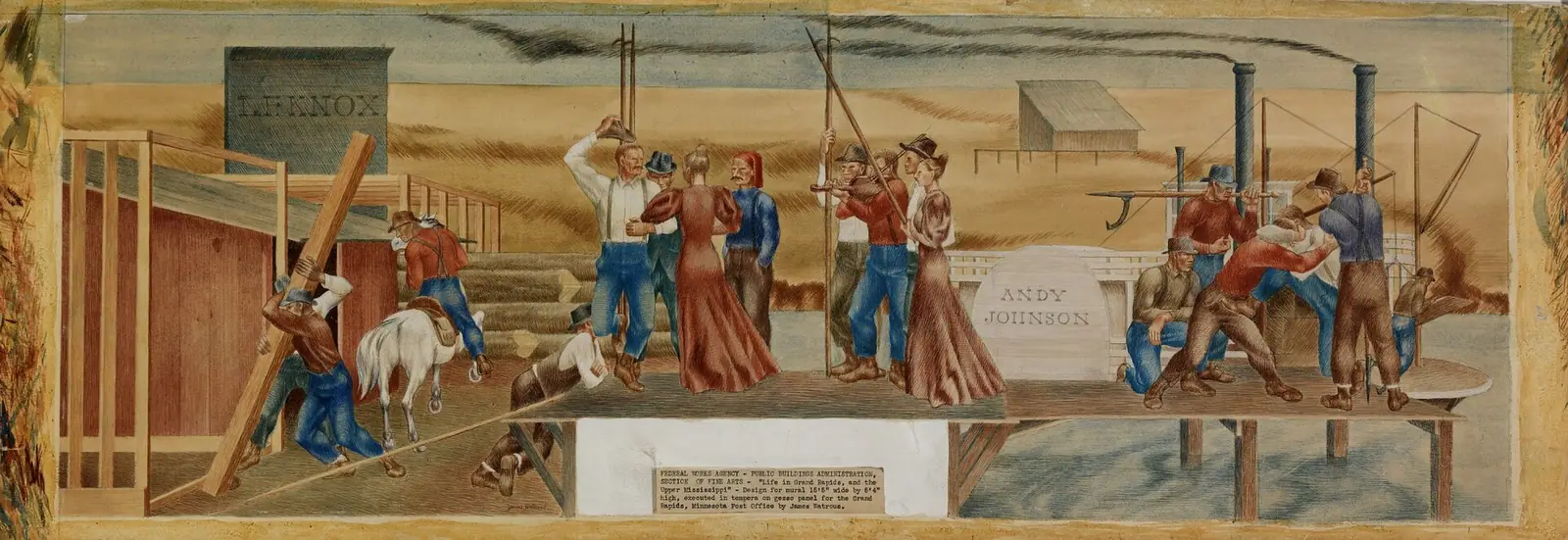
Museum
The first LEED Gold certified art museum anywhere, built by a city whose fortune came from making furniture well.
1.5–2.5 hoursRoughly $10–15 per adult; general admission free on Thursday evenings0.4 mi away
Where this place fits into a day, and the pages that plan one.
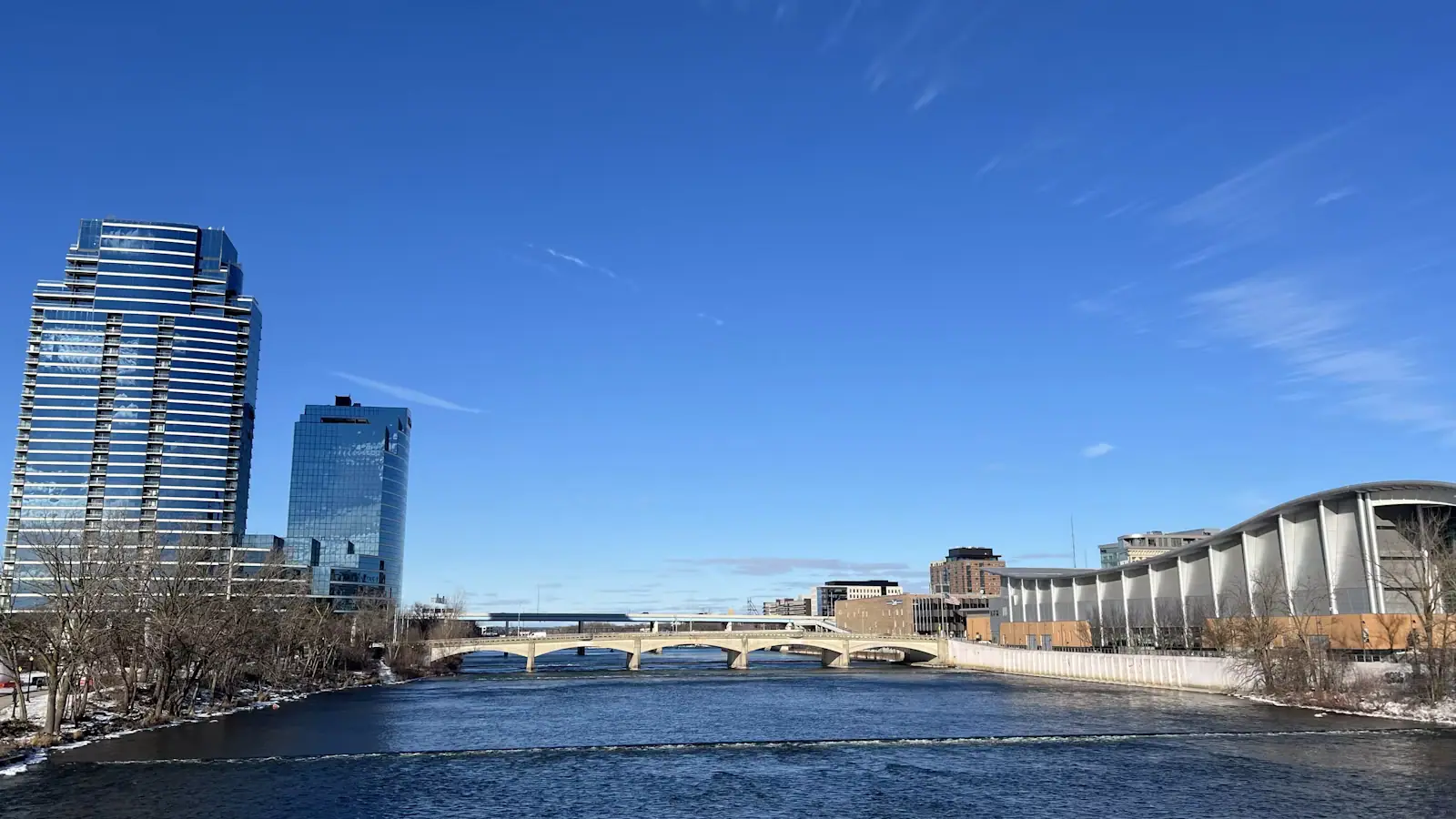
Guide hub
Furniture paid for this city, and then it paid for everything worth coming to see in it. That is the single idea a visitor needs. Grand Rapids made…
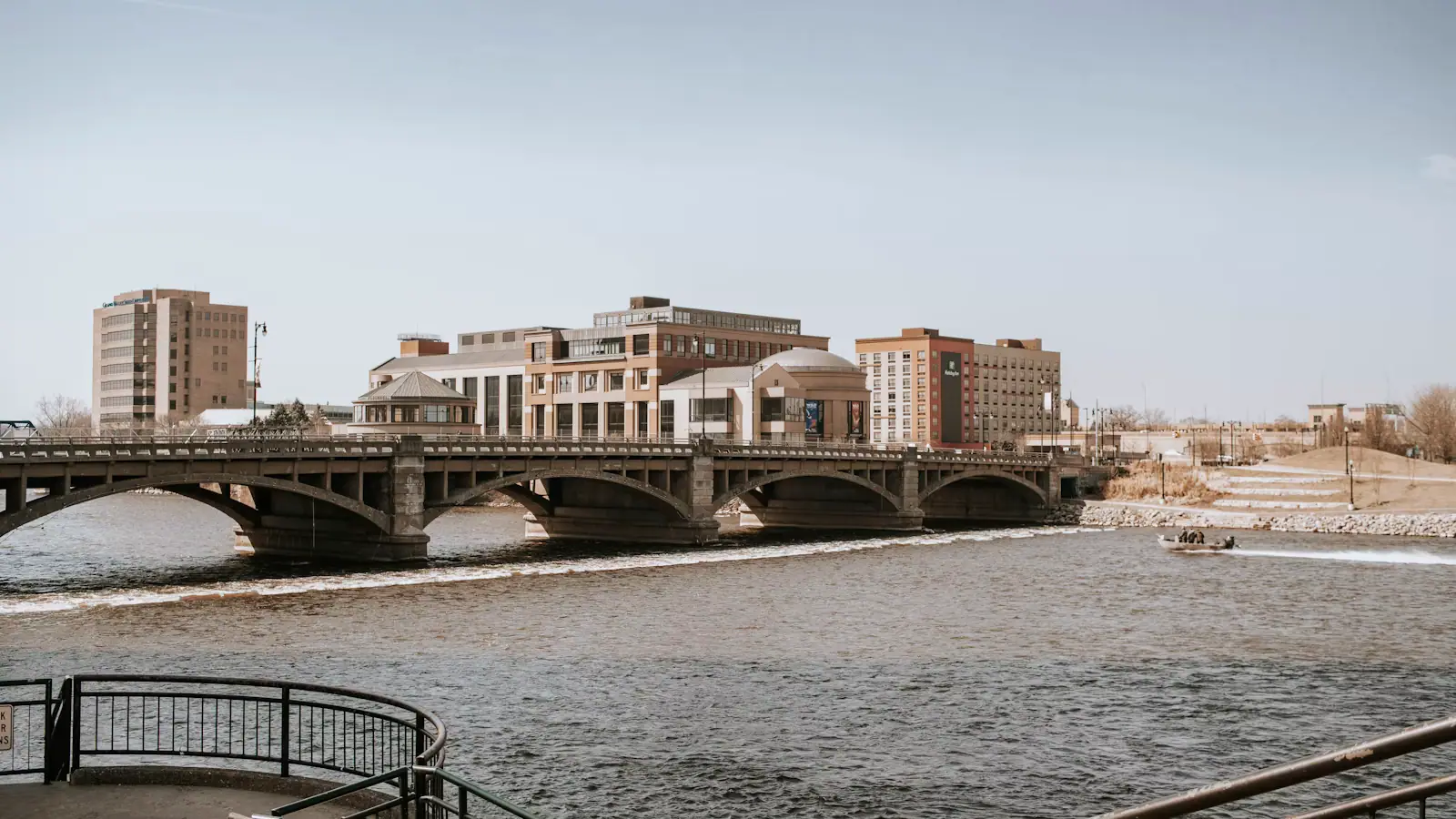
Guide hub
A city of two hundred thousand people should not have this list. Grand Rapids does, and the reason is a hundred and fifty years of manufacturing…
Things to do
Grand Rapids is overcast about two hundred and five days a year, and through the winter the sky is grey or mostly grey roughly two thirds of the…
Things to do
Every good thing in this city was paid for by chairs. That is barely an exaggeration. William Haldane opened a cabinet shop on the Grand River in…
Who it suits
Assume you will need this page. Grand Rapids takes something like thirty-eight inches of rain a year on top of around seventy-six inches of snow…
Guide
Two nights, one car, and one hard constraint that decides the whole schedule: the free Frank Lloyd Wright house only opens to the public on Sunday afternoon.
5 min readMarguerite Vanderhoff
Guide
Michigan's second city is a furniture town that spent its furniture money on art. Here is how the address grid works, what is walkable, and what needs a car.
6 min readMarguerite Vanderhoff
Guide
Seventy-odd inches of snow, the cloudiest January of any month, and a city that responds by putting a hundred art installations outdoors and flooding a Maya Lin park into an ice rink.
6 min readMarguerite Vanderhoff
Yes. President Ford was interred on the museum grounds in January 2007, and Betty Ford was buried beside him in July 2011. The tomb sits on the north lawn above the Grand River, reached by a paved path from the museum plaza. It is free to visit and does not require a museum ticket, and the grounds are open during daylight hours, generally from around 7:45am to 5pm daily.
Ninety minutes covers the permanent galleries at a normal reading pace, including the full-scale Oval Office replica, the Cabinet Room reproduction, the Watergate gallery and the Saigon embassy staircase. Allow two and a half hours if a temporary exhibition is on. Add fifteen to twenty minutes for the walk out to the gravesite and back, which most visitors do at the end rather than the beginning.
In Ann Arbor, on the University of Michigan campus, roughly two and a half hours east of Grand Rapids. Ford's is the only presidential library separated from its museum: the archive went to his university and the museum to his home town, and the National Archives runs both as one institution. Researchers want Ann Arbor. Visitors want Grand Rapids, where the exhibits, the replicas and the graves all are.
It works well for school-age children and less well for under-sixes. The Oval Office and Cabinet Room replicas are physical and interactive, and the Watergate burglary tools tend to hold attention. Younger children run out of patience in the text-heavy congressional sections. Worth a word on the path out to the gravesite so that the visit ends with an explanation rather than a surprise.